
Austin, Texas, Feb. 15
I sat down in the GEA to edit my research paper when a construction worker approached me. He asked whether a neighboring class was still in session, and I said I did not know. He commented on the current administration, and once he deemed me “safe,” he asked for my thoughts on national and local politics. Near the end of our fifteen-minute conversation, he gestured to himself and said, “We have more in common than you think. We must stick together and fight the good fight.”
The good fight can be anything. It can be the fight against poverty, the fight against racism, or even the fight against Taco Bell’s cancellation of the Quesarito. For him, the good fight meant the first two, possibly the third, and much more that is moral.
Unfortunately, fewer people are willing to join the good fight than before. The United States feels more divisive and fragmented than ever, with political scientist Robert Putnam identifying “political polarization, economic inequality, social isolation, and cultural self-centeredness” as the causes. If I were to put it in one word, it would be tribalism.
Americans are increasingly fostering a tribalistic “us vs. them” mentality, with the “us” defined by narrow constructs such as cultural identity, socioeconomic status, and political affiliation. We see “angry White men” resorting to violence against people of color out of anxiety over losing social status. We see naturalized citizens of color overlooking the aggressive immigration crackdown for better grocery prices. Overall, more Americans are prioritizing their own interests over their neighbors’ well-being, weakening the good fight.
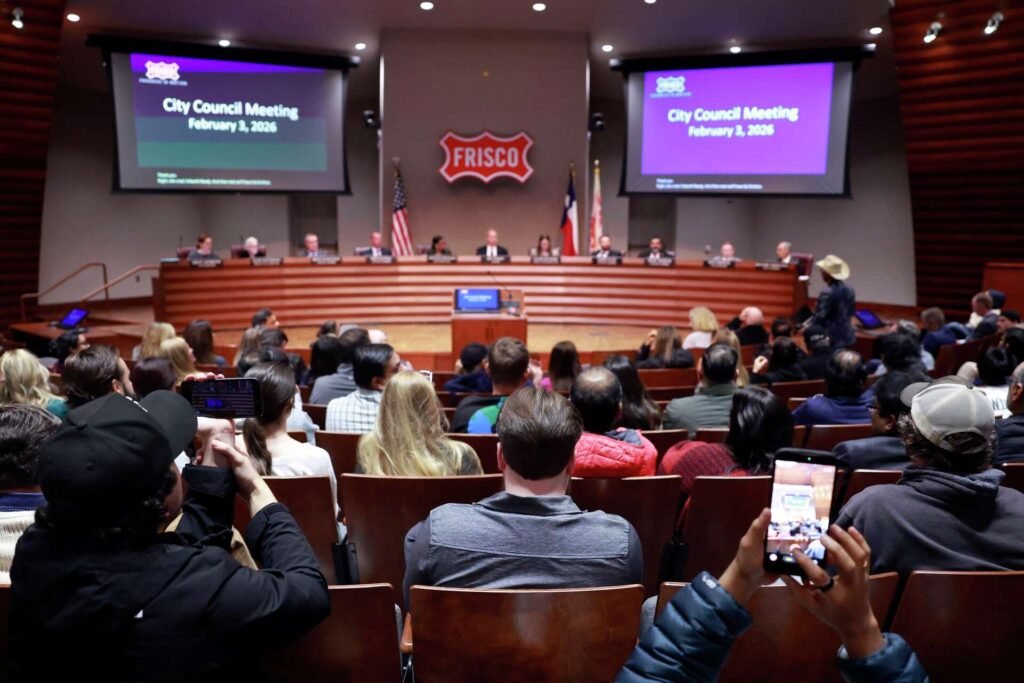
We see this even in my hometown, Frisco. On February 3, several Americans attended the Frisco council meeting to speak out against the “Indian takeover.” They not only disregarded their neighbors’ well-being but also actively called for their removal. Residents and non-residents rose to the podium to target Frisco’s Indian community for stealing jobs and “taking over through H-1B visas,” justifying their racism as economic anxiety. While the “Indians are stealing jobs” trope is overplayed, it is the first time I have seen people voice it openly for applause. Applause facilitated by the United States’ divisiveness and fragmentation.
Today, everyone is fighting for themselves, and the good fight is losing. The construction worker assumed we had something in common. Whether it was that we were people of color, that his niece was pursuing a similar education, or that we happened to be in the same hallway at the same time, he believed those commonalities were enough to join the good fight together.
However, despite living in the same city for multiple years, Americans are stepping up to the dais and saying that their Indian-origin counterparts deserve less respect because “they don’t know how to drive on the right side of the road,” “there are too many Indian grocery stores,” or more commonly, “they found a job, and I’m still searching.” Rather than joining the good fight together, possibly for a stabler job market, Frisco residents are divided and fragmented, with racist proclamations receiving standing ovations – a resounding demise of the good fight and victory of tribalism.
ASIDE: Yes, I recognize that Frisco’s Indian community is imperfect. However, it is unfair to hold the community to an impossibly high standard simply because it has not been part of Frisco since its founding in 1902. I also recognize that part of this imperfection includes the community’s silence on issues like racism and immigration, which has held back the good fight. But this silence stems from the model minority myth, which taught Indian families that staying quiet would protect their place in American society.
As Frisco’s Indian community makes room for more vocal voices, including mine, let us move forward and focus on the present. We must accept the construction worker’s truth: a loss for one of us is a loss for all, regardless of cultural identity, socioeconomic status, previous silence, or any other difference. We must fight together again, starting by refusing to tolerate council meetings like the one on February 3. Only then can the good fight win.